


Skip to content
UroLotse, Der Urologie Companion

Urology for on-call duty and training.

UroLotse supports you on call and in your own training: with on-call cards for the night, a guide to read up on and a quiz with a review schedule for the specialist exam. The content is based on the guidelines of the EAU and the German AWMF, and every page names its source.

Download on the App Store

For iPhone and iPad from iOS 17, in English and German.

  • 35 on-call cards
  • 217 guide articles
  • 1946 quiz questions
  • 7 pathways
  • As of November 2026, counted from the app’s files.
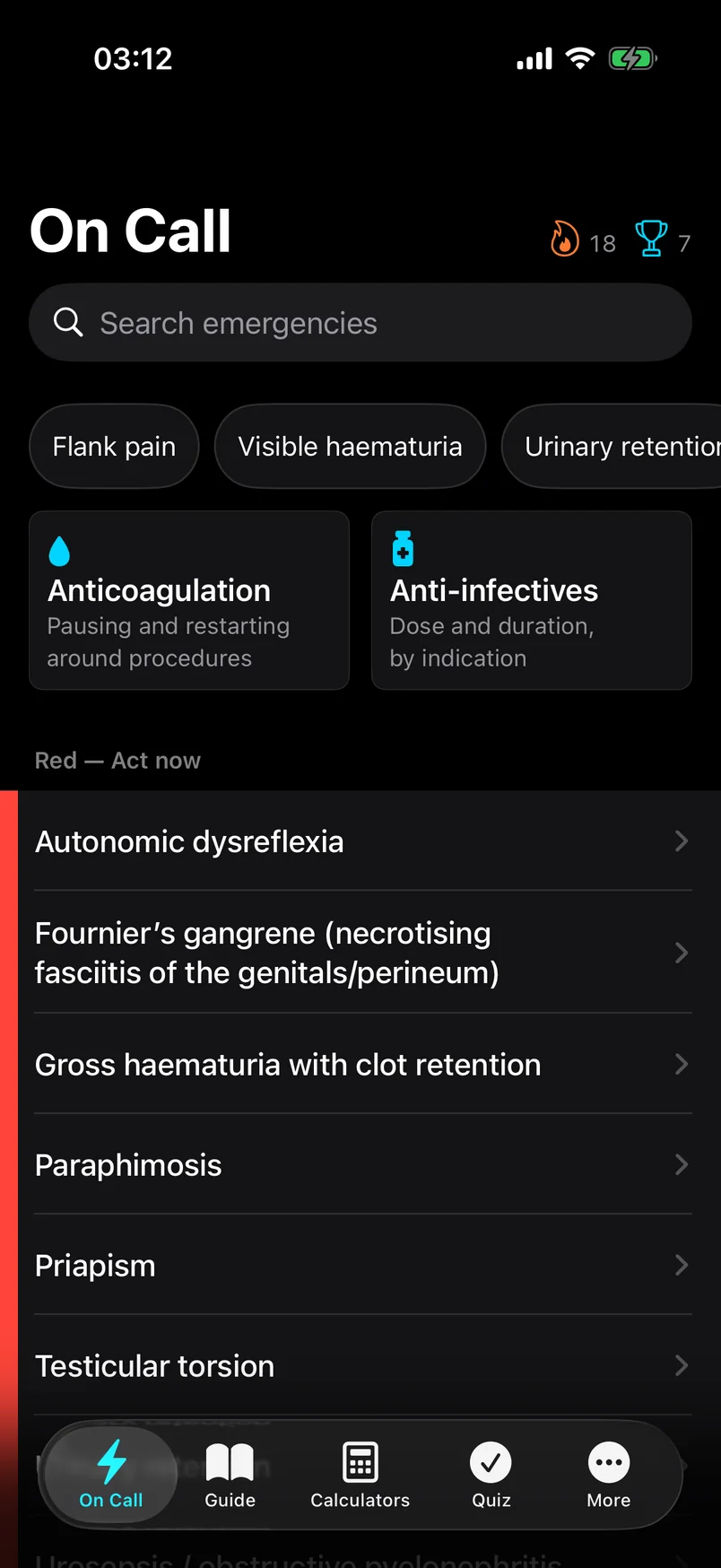
The On Call tab at night: search field, the band of presenting symptoms, the tiles Anticoagulation and Anti-infectives and the red level “Act now”, starting with Autonomic dysreflexia, Fournier’s gangrene, Gross haematuria with clot retention, Paraphimosis, Priapism and Testicular torsion.
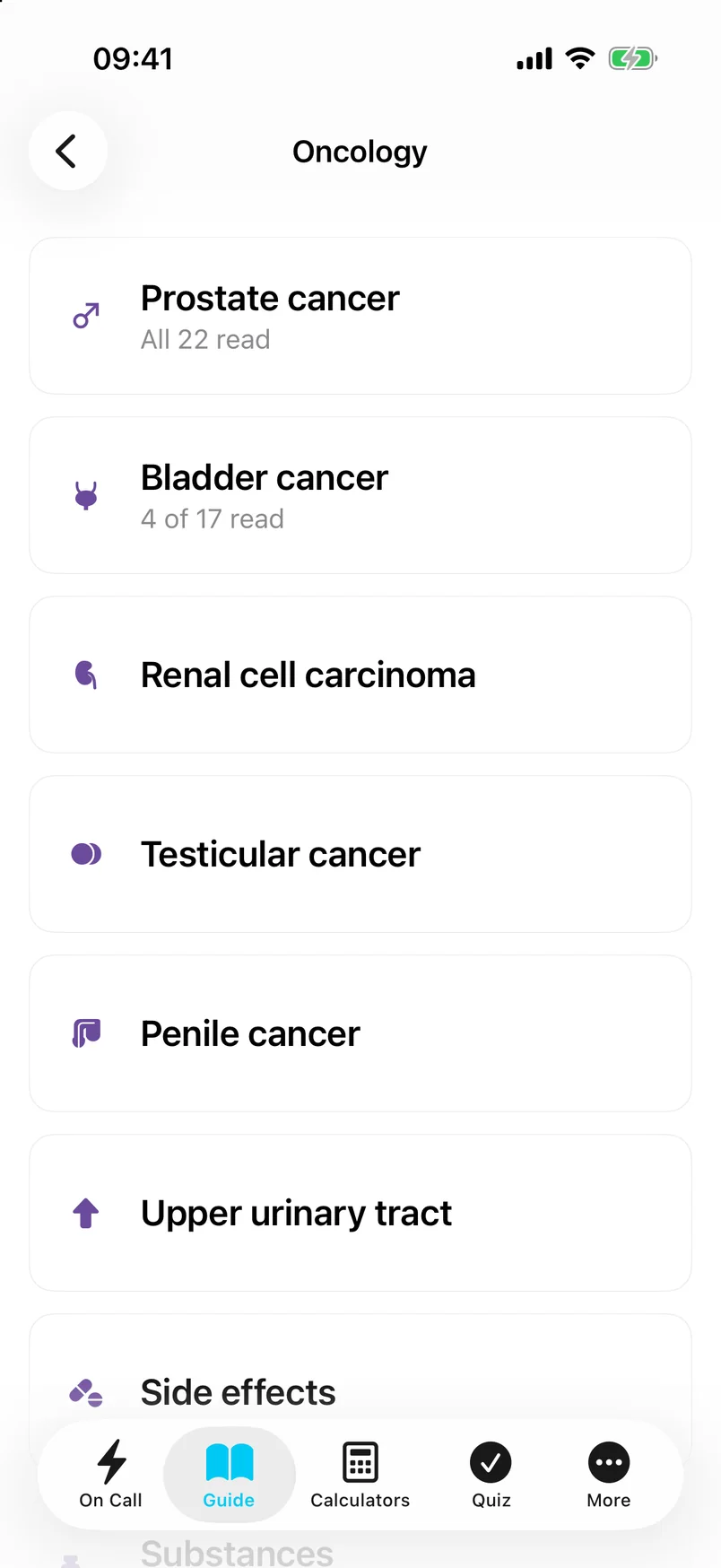
The Oncology page of the Guide, the topics as rows with marks: Prostate cancer, all 22 read, Bladder cancer, 4 of 17 read, then Renal cell carcinoma, Testicular cancer, Penile cancer, Upper urinary tract and Side effects.
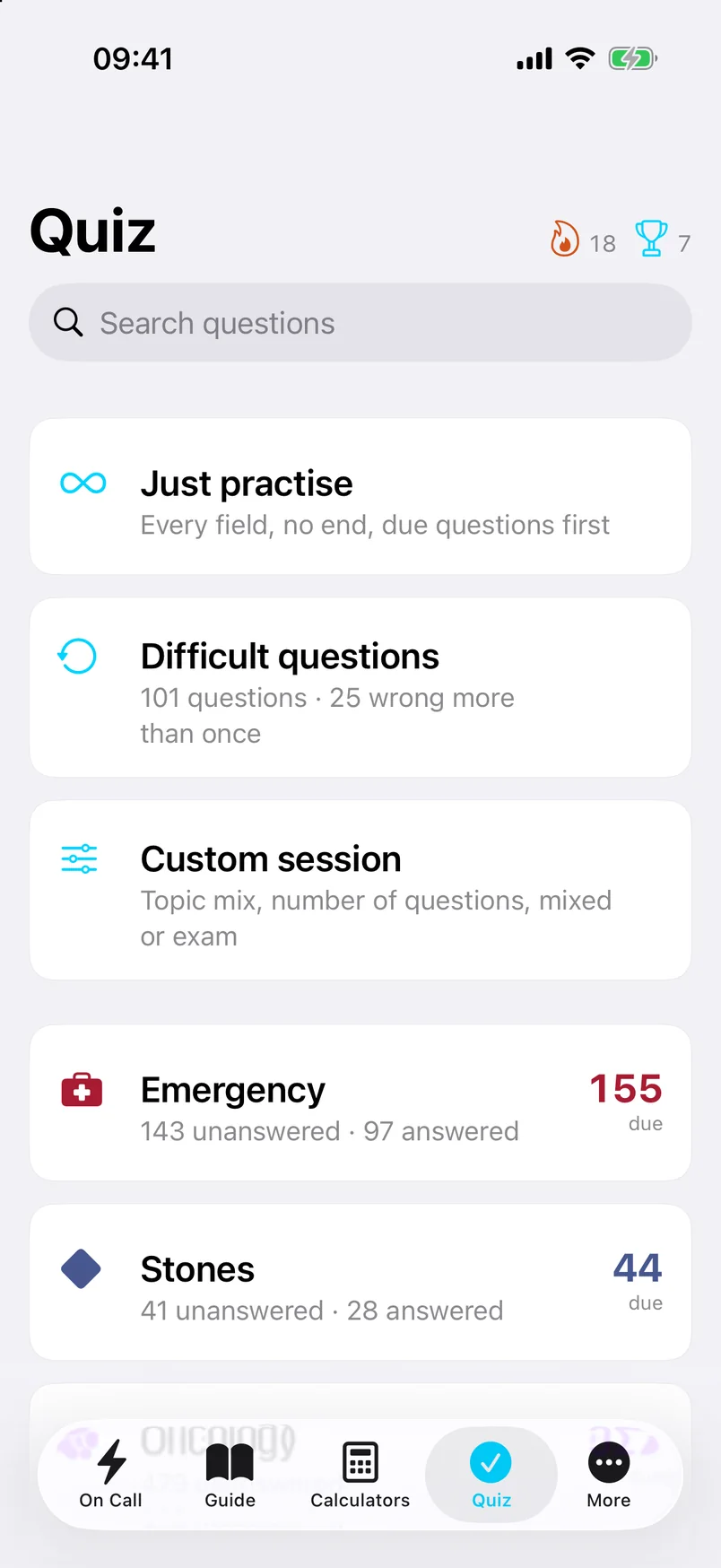
The Quiz tab: Just practise, Difficult questions, Custom session and the fields Emergency and Stones with the number of due, unanswered and answered questions.

On Call

35 on-call cards for the night, sorted by urgency: red before yellow before green, then alphabetically. A band of presenting symptoms at the top of the list filters them on the spot: flank pain, visible haematuria, urinary retention, acute scrotum, fever, catheter problem, trauma, penile pain. Two taps to the card, with one hand.

Colour column
The bars at the edge show the level: 8 red, 21 yellow and 5 green cards; the 35th, Anticoagulation, is the tile above them.
Presenting symptoms
Eight tags, because a call starts with a complaint and not with a diagnosis. A tag filters the list, and the list stays where it is.
Anticoagulation
Interruption schedule by drug and bleeding risk, plus bridging by thrombotic risk and restarting around procedures, at the top of the list next to the anti-infectives.
Anti-infectives
16 cards with dose and duration by indication, taken from the articles. A weight field works out the dose per kilogram from the dose column and caps it at the maximum dose in the same row, where that is a single number.
The card
Where there is a “Check immediately” section, it is the only collapsible card open when you arrive; everything else is one tap away. A score such as LRINEC is calculated where it appears in the text.
In depth
Further down on most cards, collapsed: one point per topic, what matters and why, with the source next to the sentence.
Night look
True black in the dark, plus large touch targets. The badge names the level in words: Act now, Urgent, Elective.
The app’s On Call tab at night: search field, a band of presenting symptoms with Flank pain, Visible haematuria and Urinary retention, the tiles Anticoagulation and Anti-infectives, below them the red level “Act now”, starting with Autonomic dysreflexia, Fournier’s gangrene, Gross haematuria with clot retention, Paraphimosis, Priapism and Testicular torsion.
The on-call list at 03:12. The red level begins, and the bar runs along the edge.
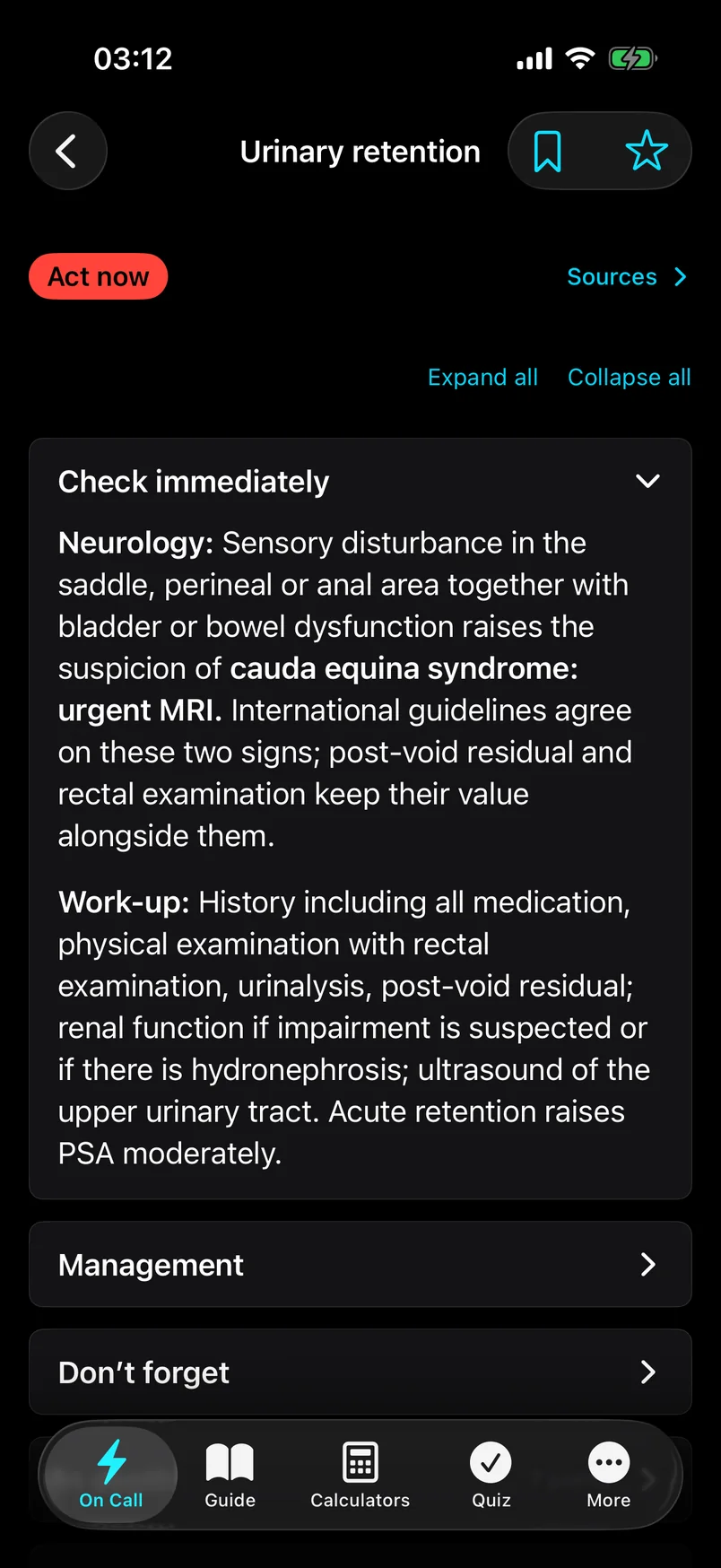
The on-call card Urinary retention: on the left the badge “Act now”, next to it on the right “Sources”, below that the card “Check immediately” open with Neurology and Work-up, then the collapsed cards Management and Don’t forget.
The Urinary retention card. “Check immediately” is open, the rest is one tap away.

The Guide

217 articles in eight fields, for looking things up on call and for studying in peace, each with its source and editorial date. Oncology is arranged by tumour, and a substance register shows in which treatment landscape a drug appears. Where the EAU and the German S3 guideline diverge, the article says so instead of resolving it. Anything newer than the guideline is marked as such.

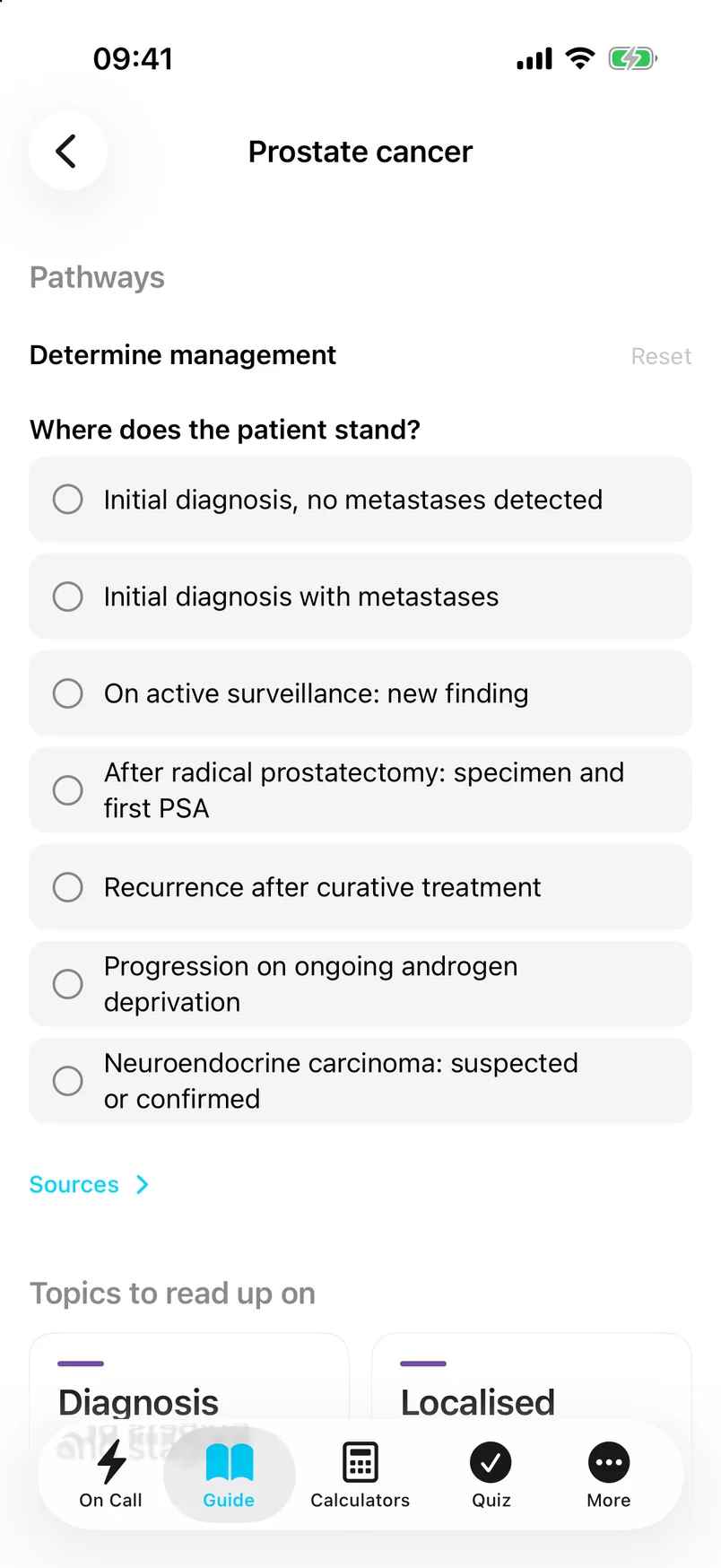
The Prostate cancer page: at the top the pathway “Determine management” with the question “Where does the patient stand?” and seven answers; below the answers the row “Sources”, then the topics to read up on, such as Diagnosis and Localised.
The Prostate cancer page: the pathway at the top, below it the topics to read up on.
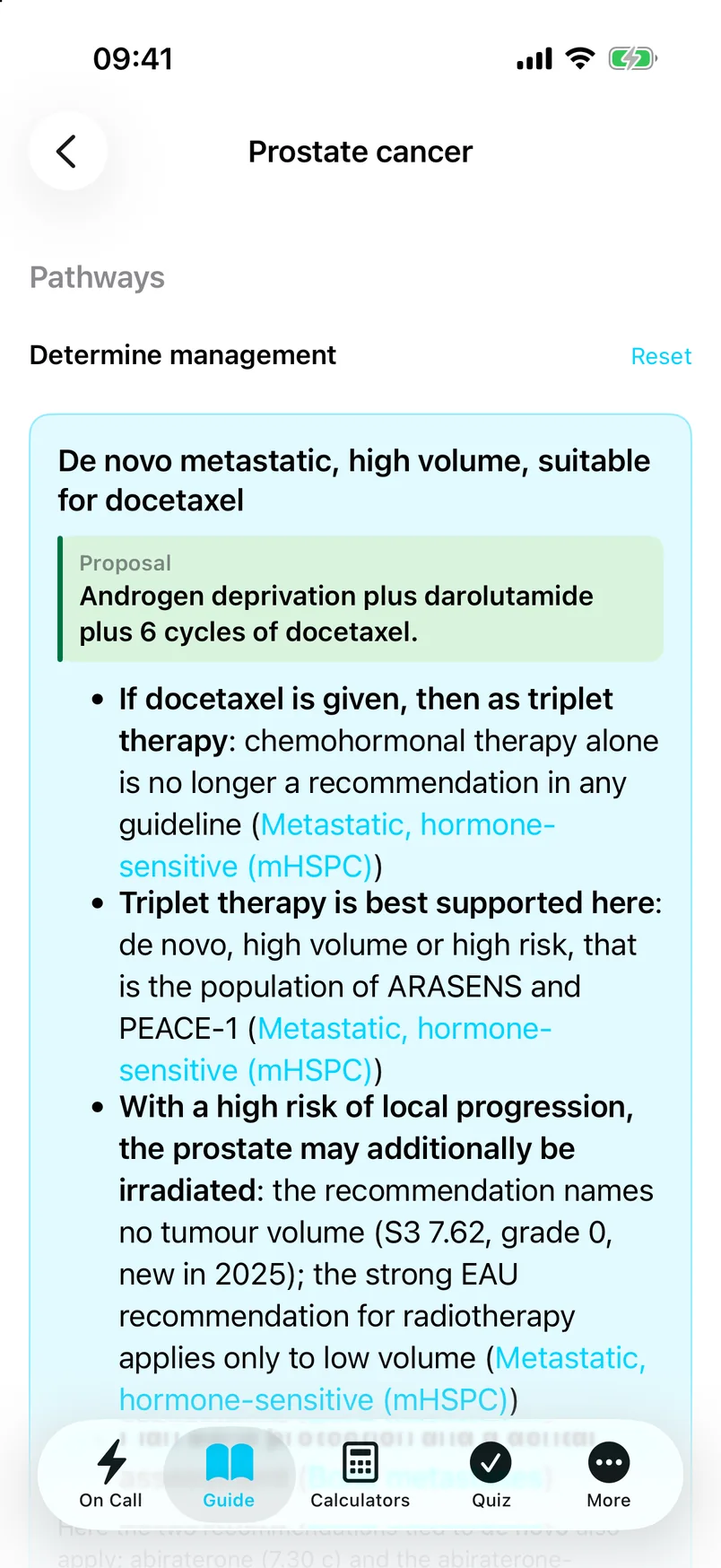
The result of the Prostate cancer pathway after three answers: De novo metastatic, high volume, suitable for docetaxel. Proposal: androgen deprivation plus darolutamide plus 6 cycles of docetaxel, below it the reasoning with references to ARASENS and PEACE-1 and to S3 recommendation 7.62.
The pathway after three answers: a proposal with reasoning, studies and recommendation grade. Every point links to its article.
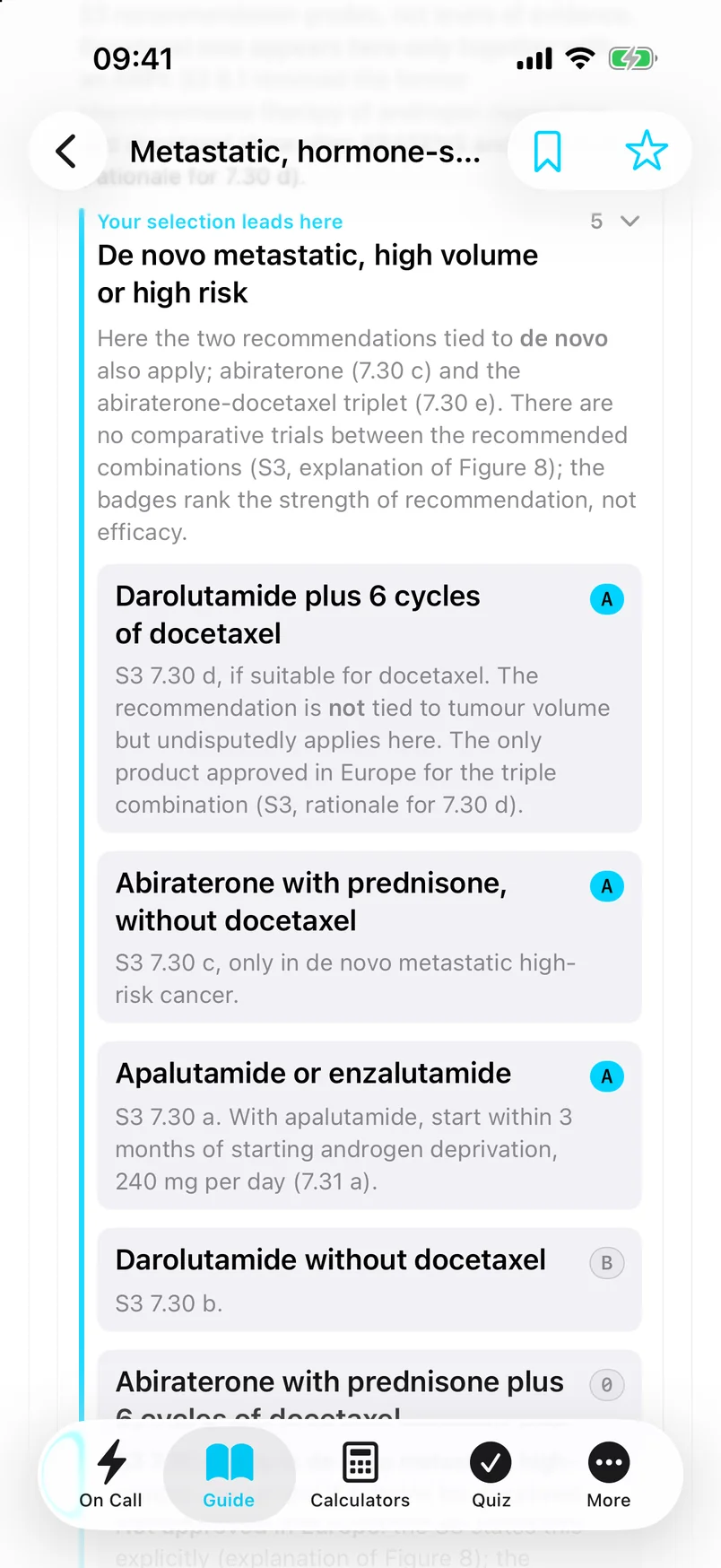
The treatment landscape in the article “Metastatic, hormone-sensitive”, opened at the branch “De novo metastatic, high volume or high risk” with the line “Your selection leads here”: regimens such as darolutamide plus 6 cycles of docetaxel and abiraterone with prednisone, each with its S3 recommendation number and recommendation grade A, B or 0 as a badge.
The treatment landscape, opened at the branch the pathway led to. The filled badge is the strong recommendation.
Treatment landscape
For each regimen, the source’s recommendation grade or level of evidence, plus the study and figures such as response rate and survival, where the source gives them. The strong recommendation is highlighted; a ranking appears only where the source states one.
Pathways
Seven: one per tumour and one for the side effects of tumour therapy. Where the treatment landscape has a matching branch, the result jumps there, with everything above it expanded.
Structure
The articles share a common structure of sections, from diagnosis through treatment to follow-up. An article uses the sections it needs.
Reading list, read, references
You put articles on your reading list and mark them as read yourself; the app never does this on its own. At the foot of an article you can see which articles refer to it, along with a link to the quiz questions derived from it.

Fields

Oncology with 118 articles on prostate, bladder, kidney, testis, penis, upper urinary tract and the side effects of systemic therapy. Also functional urology (25), paediatric urology (16), stones (15), infections (15), transplantation (12), andrology (11) and trauma (5).

What an article carries

Editorial date and source at the foot, recommendation grades next to the line they apply to, primary literature with PMID where a statement goes beyond the guideline. You can report a clinical error from any article; the draft report gives the identifier, date and source, and you see every line before it leaves the device.

The Quiz

1946 questions for your own training and the specialist exam. Often a case, always four answers, and immediate feedback with an explanation and the source article. The review schedule follows the FSRS method: what you got wrong comes back sooner. For the exam there is an exam mode with the results at the end.

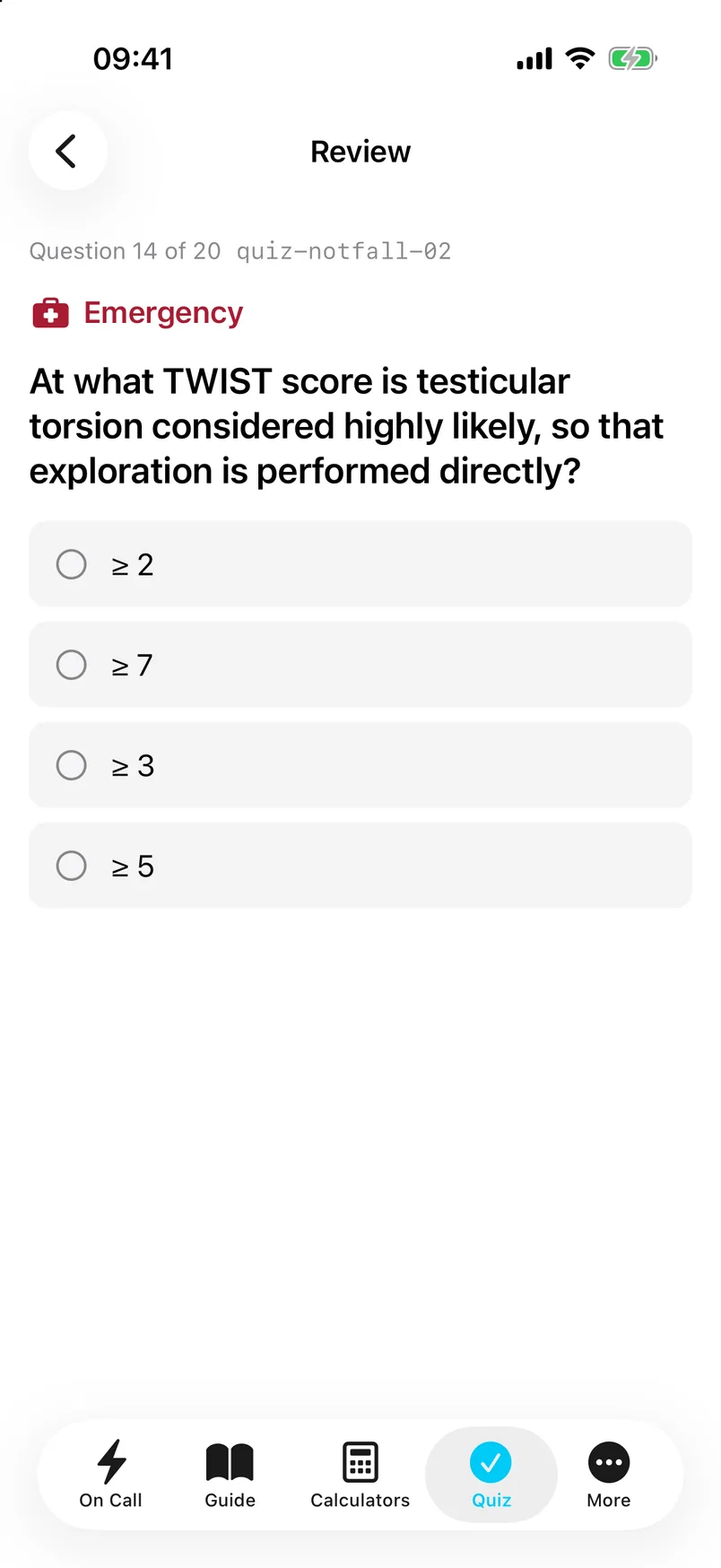
A “Review” quiz session, question 14 of 20, numbered quiz-notfall-02: above the stem the field Emergency and the question at what TWIST score testicular torsion is considered highly likely, so that exploration is performed directly. Below it four answers: ≥ 2, ≥ 7, ≥ 3 and ≥ 5.
The question names its field and its number; the answers are shuffled.
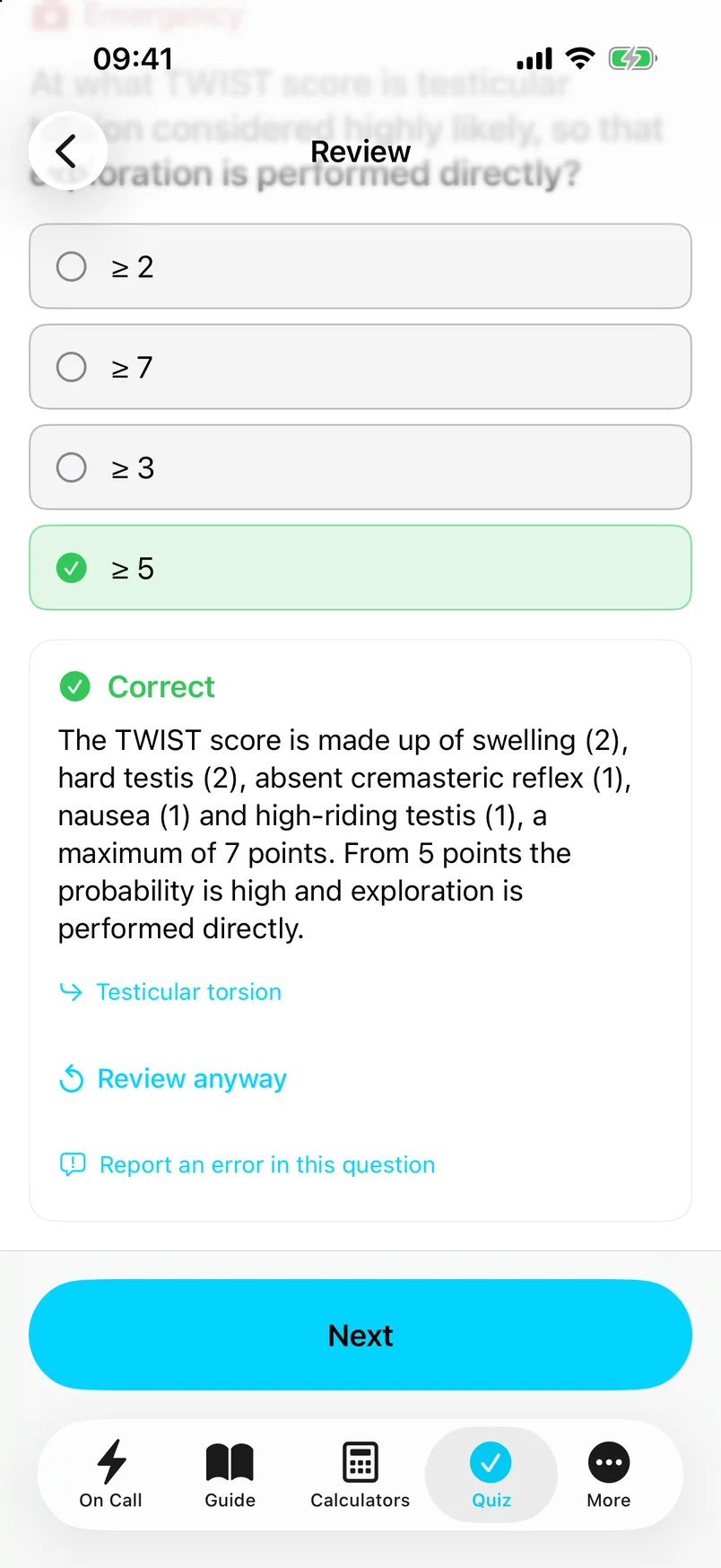
The same question answered: ≥ 5 is marked green, below it “Correct” with a tick and the explanation that the TWIST score is made up of swelling, hard testis, absent cremasteric reflex, nausea and high-riding testis, with a maximum of 7 points, and that from 5 points the probability is high and exploration is performed directly. Then the link to the article “Testicular torsion”, “Review anyway” and “Report an error in this question”, and at the bottom the “Next” button.
The feedback with symbol and word, the explanation and the link to the article.
Derived, not invented
Every correct answer is in the text of an article in the app, and the question names it. Exam questions from other sources are not used.
Fields
Nine fields, with oncology by tumour. In a custom session you mix fields and choose the number of questions and the mode: review, mixed or exam.
Just practise
Questions without end from every field, due ones first, then new ones, then those you are most likely to have forgotten.
Difficult questions
Sorted by failed attempts, as a complement to the due review.
The pilot raises both flags overhead.
Correct on a question you missed earlier: a short animation, sometimes a traffic light, tick or barrier, sometimes the pilot with raised flags.
The pilot crosses both arms, the flags pointing down.
Wrong: an animation on every wrong answer, sometimes the pilot with crossed arms; the explanation is below it. In exam mode none appears during the questions.
The pilot holds up a golden trophy.
Streak and trophies, optional: you are asked on first launch and can switch later under “More”. Notifications only with your consent.

The Calculators tab

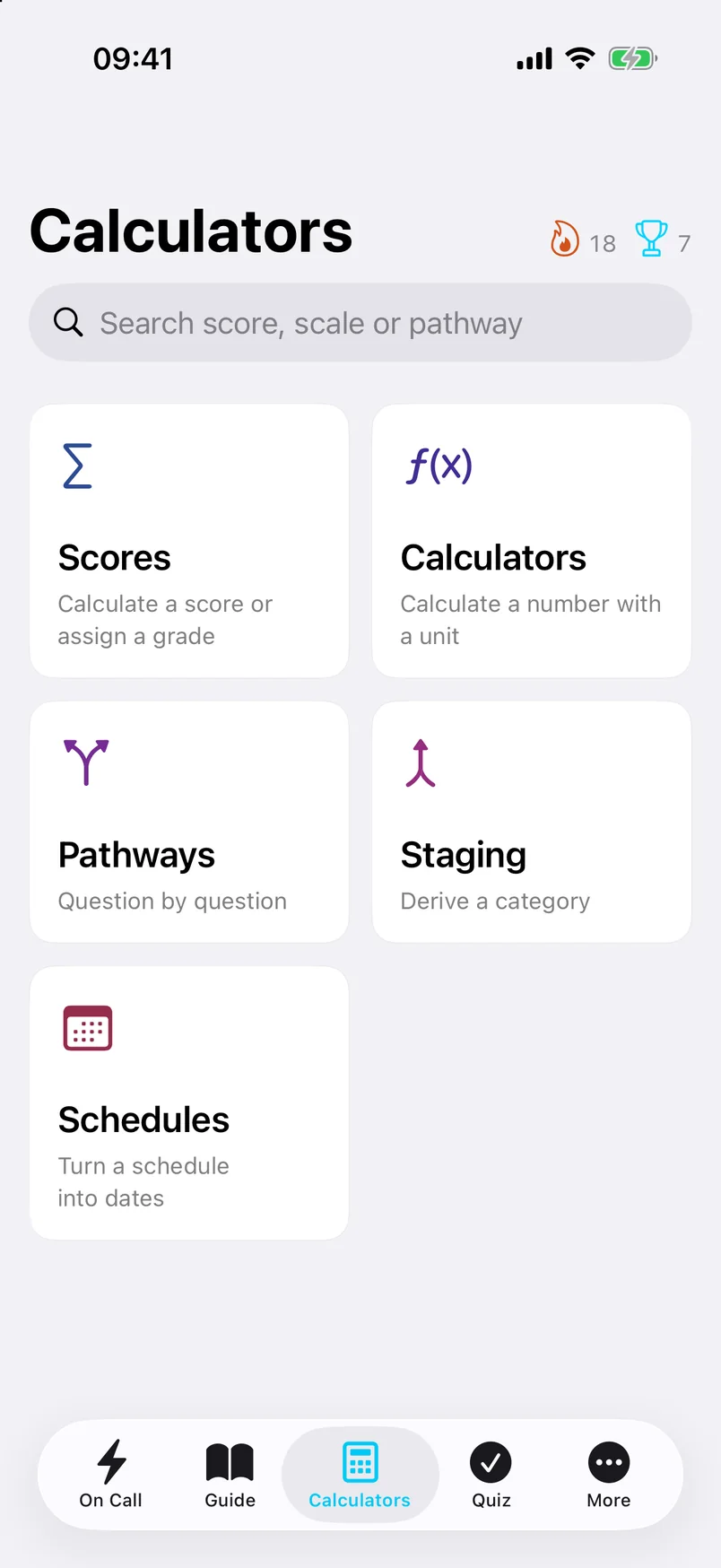
Every score, scale, staging card, schedule and pathway sits in the article where it is needed, and again in the Calculators tab, three taps from launch, two if pinned. The list is built from the articles; nothing is maintained by hand.

20Scores and scales
Calculate a score or assign a grade: LRINEC, Leibovich, IMDC, IPSS, NIH-CPSI, ECOG, Clavien-Dindo, AAST.
4Calculators
A number with a unit: PSA doubling time, creatinine clearance, PSA density, bladder capacity in children.
7Pathways
Question by question: one per tumour, plus one for side effects.
9Staging cards
Derive a category: clinical stage, IGCCCG, D’Amico, EAU risk groups.
20Schedule cards
Turn a schedule into dates: follow-up, instillation and check-ups according to the guidelines, each date with its weekday.

Pin what you need every week at the top. Below a stated threshold the app claims nothing, and every card names its source. Entries are not stored: a patient’s findings exist only while the card is open.

The Calculators tab with the five tiles Scores, Calculators, Pathways, Staging and Schedules, each with a line naming what it does.
Five tiles; under each one it says what happens behind it.
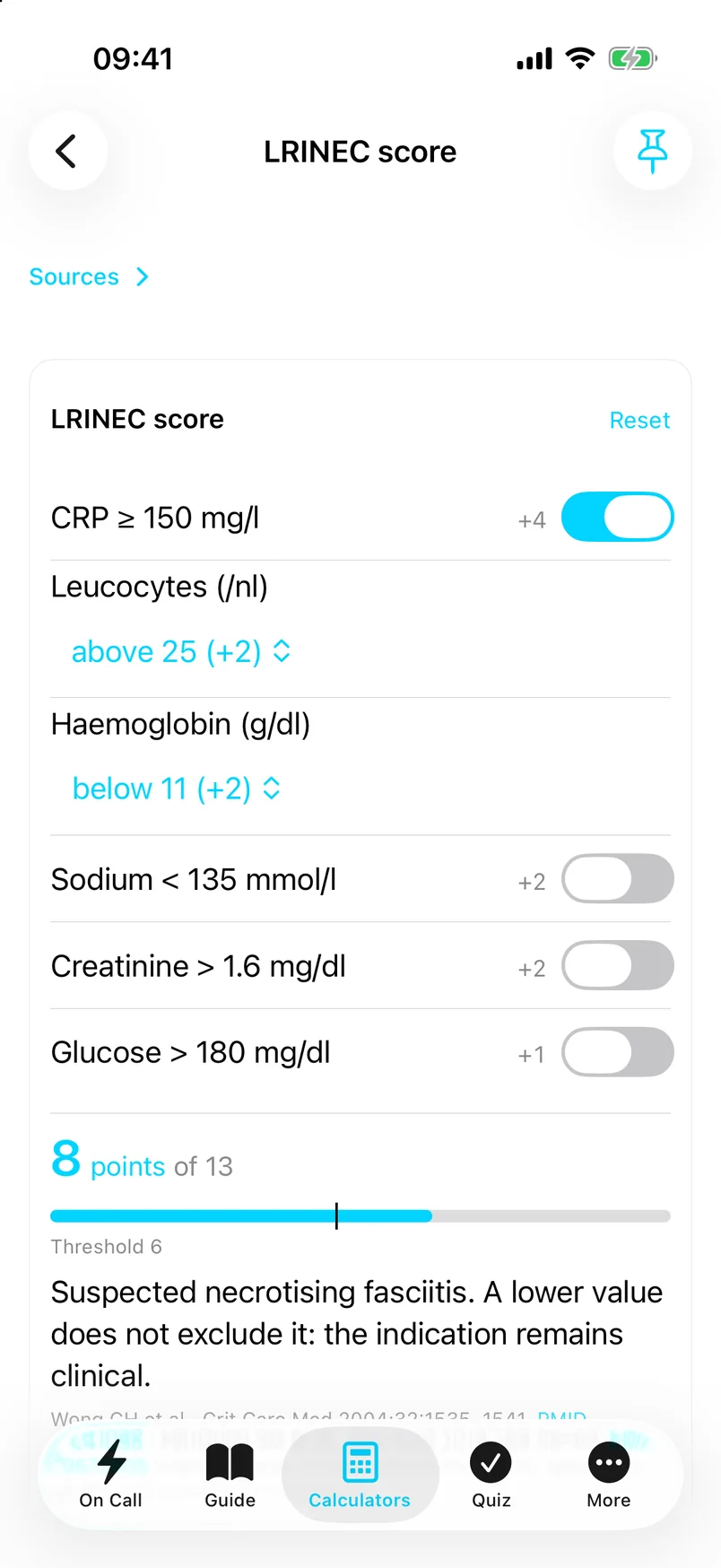
The LRINEC score in the Calculators tab: “Sources” at the top, below it the card with CRP from 150 mg/l switched on, leucocytes above 25 and haemoglobin below 11 selected, 8 points of 13, the bar with threshold 6 and the interpretation “Suspected necrotising fasciitis”.
LRINEC on its card: tick the criteria, and the total appears with threshold and interpretation, with the sources above.

Where the content comes from

From the guidelines of the European Association of Urology and the German AWMF, supplemented by guidelines of other societies, primary literature, EMA product information and the CTCAE. Every line names its source. A contradiction between two guidelines is named, not decided.

EAU Guidelines 2026

  • Prostate Cancer2026
  • Non-muscle-invasive Bladder Cancer2026
  • Muscle-invasive and Metastatic Bladder Cancer2026
  • Upper Urinary Tract Urothelial Carcinoma2026
  • Renal Cell Carcinoma2026
  • Testicular Cancer2026
  • Penile Cancer2026
  • Urological Infections2026
  • Urolithiasis2026
  • Urological Trauma2026
  • Renal Transplantation2026
  • Paediatric Urology2026
  • Sexual and Reproductive Health2026
  • Non-neurogenic Female LUTS · Male LUTS2026
  • Neuro-urology · Urethral Strictures2026
  • Chronic Pelvic Pain2026

AWMF S3 guidelines

  • Prostatakarzinom8.1, 2025
  • Harnblasenkarzinom3.0, 2025 · Amendment 3.1, 2026
  • Nierenzellkarzinom2024
  • Hodentumoren1.1, 2020
  • Peniskarzinom1.0, 2020

Also

  • Primary literature with PMID, checked against the abstractPubMed
  • Product informationEMA, emc
  • CTCAE v5.0, AGIHONCI, Onkopedia
  • Further guidelines: NICE, KDIGO, Surviving Sepsis Campaign, Consortium for Spinal Cord Medicine, Endocrine Society, ASHOn-call cards
  • AUA: Male Chronic Pelvic Pain 2025, Advanced Prostate Cancer 2026 (with SUO); for metastatic renal cell carcinoma a treatment algorithm based on EAU, ESMO and NCCNGuide

UroLotse replaces neither clinical judgement nor checking the primary literature and the current guidelines. Responsibility for every treatment decision lies with the treating doctor. The editorial date is on every page.

One subscription, everything included.

Monthly and cancellable, or a full year at the lower price. Both subscriptions unlock the same content.

UroLotse

Billing

€9.99 /month

cancel monthly

€99.00 /year

Monthly: 12 × €9.99 = €119.88

equivalent to €8.25 per month

Try free for 7 days

The trial is available once per Apple ID; if you cancel up to 24 hours before it ends, you pay nothing.

  • All the content in the app, including everything added later
    • 35 on-call cards
    • 217 guide articles based on the EAU and AWMF guidelines
    • Calculators, staging, schedules and 7 pathways
    • 1946 quiz questions with a review schedule
    • Figures as of November 2026
  • iPhone and iPad, from iOS 17
  • Sign in with Apple, no password and no registration
  • Learning progress in your private iCloud, no analytics and no tracking
  • Works offline once the app is open; every cold start checks with Apple once
  • Cancel at any time in the iOS settings, up to 24 hours before the end of the current month or year

Prices in euros including VAT, billed through your Apple ID. The price and trial shown by the App Store at purchase apply. The terms and the right of withdrawal and the privacy policy apply.

Questions

Who is UroLotse for?

For doctors in urology, primarily in specialty training, and for all healthcare professionals who need a reference for on-call duty, a guide for their own training and a review tool for the specialist exam. The app asks about this on first launch. It is not intended for patients.

Does the app replace the guideline?

No. It is derived from the guidelines, names its source at every point and gives the editorial date on every page. Where the sources contradict each other, the contradiction is stated. The decision about the patient remains yours.

Which languages is UroLotse available in?

In English and German: the whole app with all cards, articles and quiz questions. You choose the language on first launch and at any time at the top right under “More”. For the legal texts, the German version applies; the English one is a translation.

Does the app work without a network?

All articles, cards and questions are in the app; nothing is downloaded later. Every cold start checks once with Apple whether your sign-in and subscription are valid, and that needs a brief connection. After that, search, on-call cards, Guide, Calculators and Quiz keep working without a network, and your learning progress syncs as soon as there is one again.

What happens to my data?

Through the app, the provider stores only what you write to him yourself. What the app stores is on your device and in the private iCloud of your Apple account; sign-in, subscription and iCloud run through Apple. Only two things go from your device to the provider: an email you send yourself, and, when you delete your account, a code that is simply passed on to Apple. Patient data is never stored: what you enter in a calculator exists only while the card is open. Everything else is in the privacy policy.

Is there an Android version?

Not at present. UroLotse is built for iPhone and iPad, from iOS 17.

How do I report an error?

From any article and under every answered quiz question: the app prepares an email to support@urolotse.at, with identifier, date and source visible in the text. Malfunctions and requests go to the same address. Please do not include any patient data.